










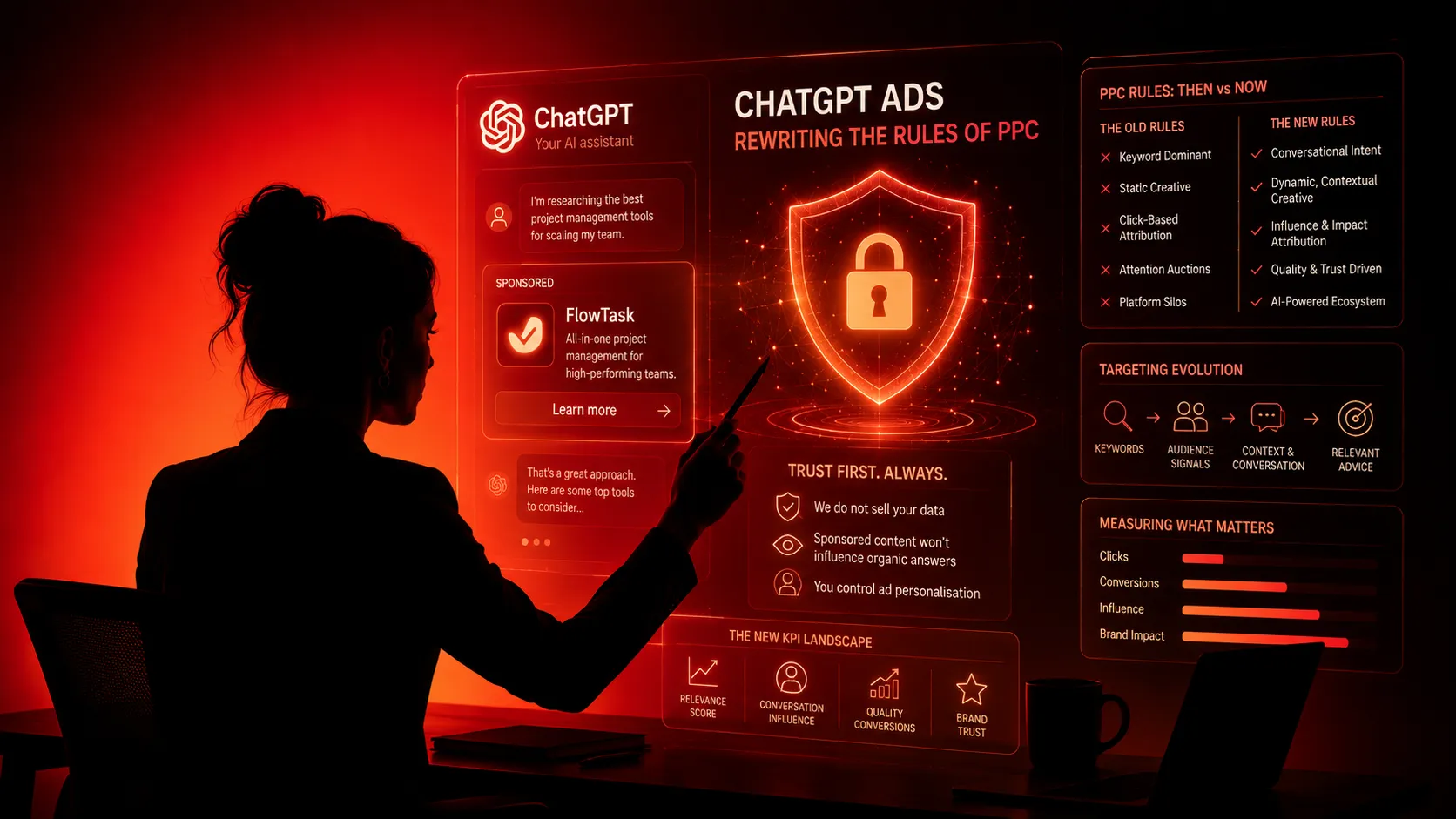
ChatGPT Ads Will Rewrite PPC Rules We Thought Were Sacred
When your biggest competitor is Google—a platform built entirely on advertising revenue—and Meta's spent years perfecting AI algorithms for ad targeting, OpenAI was never going to leave that money on
When your biggest competitor is Google—a platform built entirely on advertising revenue—and Meta's spent years perfecting AI algorithms for ad targeting, OpenAI was never going to leave that money on the table. Especially not when they lost $5 billion in 2024 on just $3.7 billion in revenue.
The maths is brutal. Only 5% of ChatGPT's 800 million monthly users pay for subscriptions. That's not a sustainable business model when you're haemorrhaging cash on computational costs.
But here's what actually matters for PPC practitioners: this isn't just another ad platform launching. This is a fundamental shift in how advertising works.
The Trust Paradox Nobody's Talking About
People give ChatGPT absurd amounts of context about their lives.
I've told it about my partner's coeliac disease, her birthday, the level of research I'm doing for a bread maker purchase. It knows my work patterns, my writing style, even aspects of my mental health through casual conversations.
That's powerful data. It's also terrifying from a trust perspective.
If ChatGPT starts suggesting ads for psychologists based on mental health conversations, or pushes counselling services when someone's vulnerable, that trust evaporates. Fast.
The challenge isn't whether ChatGPT can monetise attention—it's whether it can do so without destroying the very thing that makes it valuable.
OpenAI claims it won't sell user data and that sponsored content won't influence organic answers. They say users can turn off ad personalisation anytime.
I want to believe that. But I've watched enough tech companies make similar promises before revenue pressure kicked in.
Keywords Aren't Dead (But They're Not Enough)
Here's where most analysis gets it wrong: people assume conversational AI kills keyword targeting.
It doesn't.
Keywords will still matter for bringing intent into the system. But ChatGPT won't stop there. It can layer demographic targeting, audience signals, and contextual understanding on top of basic keyword matching.
Think about retargeting through a ChatGPT pixel. You research a product using ChatGPT, it sends you to a website, and suddenly those ads follow you back into your ChatGPT conversations. That's not speculation—that's the logical next step.
The real question is how much conversational context OpenAI will actually use for targeting. My guess? They'll start conservative with demographic and audience-based approaches because using hyper-specific conversational context feels too invasive.
Using too much context too quickly would be dangerous. And OpenAI knows it.
Creative Needs to Sound Like Advice, Not Advertising
Traditional ad copy dies in conversational environments.
"Buy Best Running Shoes" doesn't work when someone's having a natural conversation about marathon training. The ad needs to read like helpful advice: "Based on your marathon training, the [Brand] Pro series offers the stability you need."
That's a fundamental creative shift.
Right now, we're only seeing simple display ads in beta testing. OpenAI is watching user reactions carefully. If there's backlash, if people start deleting the app and moving to Claude or Gemini, they'll adjust fast.
Nothing's set in stone yet. But the direction is clear: ads need to feel native to conversation, not interruptions of it.
Traditional A/B testing can't optimise for dynamic, context-aware responses that change based on each user's unique conversation. We'll need entirely new creative frameworks.
Attribution Gets Complicated (And That's Actually Fine)
Here's the uncomfortable truth: when an AI assistant recommends your product and someone buys it without clicking a trackable link, traditional attribution breaks.
The influence happens invisibly.
Multi-touch attribution already struggles with cross-device behaviour and Apple's privacy updates. AI-mediated interactions make it worse.
But here's where it gets interesting: ChatGPT's agentic browser might actually make attribution easier than we expect. If you're using ChatGPT's browser to complete purchases, that traffic becomes trackable—you just need to customise your analytics setup to recognise it.
Google Analytics won't track AI traffic out of the box. You'll need to make changes. But that creates opportunity for marketers who move early.
We'll shift from direct attribution to correlation and modelled impact. Marketing Mix Modelling and incrementality testing become more important. Measuring AI presence becomes the new proxy for influence.
The CPA Model Could Change Everything
Most people assume ChatGPT will use Google's auction model: whoever pays most gets the placement.
But there's another option that would maintain trust whilst driving quality: cost-per-acquisition bidding.
In a CPA model, ads get promoted based on how well they convert, not just how much advertisers pay. If your CPA through ChatGPT is too high, you're out. That means only products people actually want stay in the system.
It's a quality-first approach that rewards conversion over cash.
Will OpenAI actually do this? Probably not entirely. The commoditisation of attention is too profitable for any capitalist company to ignore completely. But they might blend approaches—using CPA as a quality filter whilst still running auctions.
The bidding war nobody's prepared for isn't about who pays most—it's about who converts best.
The Skills Gap Is Already Here
PPC professionals in the nineties were skilled mathematicians. Now we need to become powerful wielders of AI.
That's not hyperbole.
You'll need to use AI to analyse huge volumes of data, pull insights from complex datasets, and generate creative variations at scale. Generic ads will blend into the background. Fresh, interesting, informative ads—updated almost daily—will become the norm.
The only way to generate that level of output is through AI-powered workflows for both data analysis and creative production.
PPC professionals will need to be quick and reactive. You might create new ad sets daily to respond to market conditions. That's a completely different operating model from setting up campaigns that run for months.
The question isn't whether AI will change PPC skills—it's whether you're building those capabilities now or waiting until you're already behind.
When This Actually Matters for Your Business
OpenAI announced on 16 January 2026 that ads launch "in the coming weeks" for free and Go tier users in the U.S.
This isn't speculation anymore. It's happening now.
But here's my honest timeline assessment: most businesses don't need to panic immediately.
ChatGPT is starting from scratch. Google has 20+ years of search data, quality-scoring systems, auction infrastructure, and proven measurement frameworks. ChatGPT has none of that legacy—which is both an advantage and a limitation.
They can learn from Google's playbook and Perplexity's mistakes. They can design something better from day one. But it will take time to perfect their ad model and establish it as a dominant alternative.
Gartner predicts traditional search volume will drop by over 25% by 2026 as people shift to answer engines. EMarketer projects AI-driven search ad spending in the U.S. could surge from $1.1 billion in 2025 to $26 billion by 2029.
Those numbers suggest this matters sooner than most people think, but not tomorrow.
Start preparing your data infrastructure now. Get your analytics ready to track AI traffic. Experiment with conversational creative approaches. Build internal AI capabilities for data analysis and creative production.
But don't abandon your Google campaigns in panic.
What I'm Watching For
The real test comes when we see user behaviour data.
Do people actually click ChatGPT ads? Do they trust recommendations that appear alongside sponsored content? Does ad presence change how people use ChatGPT?
If users start perceiving ChatGPT as prioritising advertisers over accuracy, the brand loses credibility. Trust is hard to rebuild when competitors like Claude and Gemini offer ad-free experiences.
OpenAI faces a brutal trade-off: they need advertising revenue to survive, but aggressive monetisation could destroy the product's core value.
I'm curious to see how they balance that. Because the way they solve this problem will reshape PPC for everyone.
The sacred rules of PPC we've followed for decades—keyword dominance, static creative, click-based attribution, attention auctions—are all up for renegotiation.
Whether that's exciting or terrifying depends entirely on how prepared you are.
More insights




Stay sharp on what works
No fluff. No clickbait. Just content that actually helps.