










Has AI SEO Changed the Search Landscape?
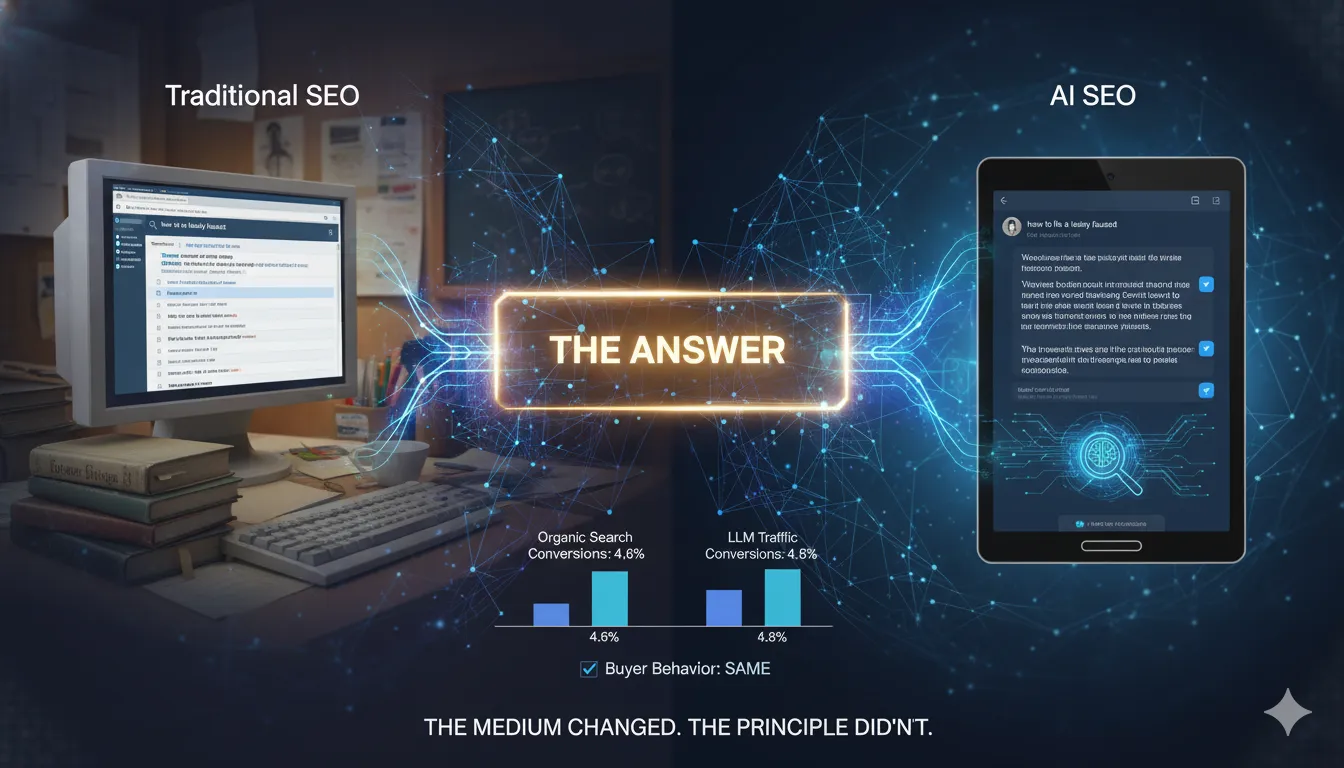
SEO has always been about answering questions.
SEO has always been about answering questions.
Twenty years ago, you stuffed keywords. Ten years ago, you optimized for long-tail phrases. Today, people ask ChatGPT and Claude direct questions.
The medium changed. The principle didn't.
The Real Shift Nobody's Talking About
Here's what actually matters: LLM traffic jumped 527% between 2024 and 2025. Some sites went from 600 monthly ChatGPT visits to over 22,000.
But here's the thing everyone misses.
Those visitors convert at basically the same rate as organic search. Around 4.8% versus 4.6%. The traffic source changed, but buyer behaviour didn't.
So when people ask me about " AI SEO strategy," I tell them to stop thinking about it as something new. You're still trying to be the best answer to someone's question.
The One Percent Strategy
Let's face it: most businesses will never capture more than 10% of the global market. Companies like Google and Microsoft? Sure. Everyone else? You're fighting for 1%.
That's not a problem. That's an opportunity.
One percent of the population is more than enough for an insanely thriving business. So stop trying to please everyone and start resonating deeply with your niche.
When someone asks Claude or ChatGPT a hyper-specific question about your industry, you want to be the site that answers it. Not with generic advice. With the exact answer they're looking for.
This means thinking about the actual questions your 1% asks. Then answering them clearly, completely, and uniquely.
Why Third-Party Validation Became Critical
Here's where things get interesting.
LLMs think like journalists now. They want corroboration. Verified sources appear in 73% of high-visibility AI answers versus just 48% for non-verified content.
You can't just claim you're great at something on your website anymore. You need third parties saying it too. Case studies. News articles. Reviews. External validation.
Google wanted trust signals through backlinks. AI systems want journalistic sourcing.
The strategy? Content first, then PR. Make sure you're talking about your expertise on your own site before you push messages externally. Otherwise, AI finds contradictory information and gets confused about what you actually do.
What Actually Stayed The Same
Technical fundamentals still matter. Broken links, slow load times, poor user experience? Google won't rank you, and AI won't trust you.
Create rich, engaging content that's genuinely useful. Make it unique. Run surveys. Ask questions nobody else is asking. Pull in data that creates fresh perspectives.
These principles worked in 2005. They work in 2025. They'll work in 2035.
Measuring What Matters
The industry is scrambling to figure out new metrics. Tools like SEMrush and Ahrefs now have LLM prompting features that check if you're mentioned in AI responses.
But for me, the key metric is simple: conversions from LLM traffic.
Whether visitors come from Claude, Gemini, or ChatGPT doesn't matter. What matters is whether they convert. Track that. Optimize for that.
Rankings are vanity metrics. Revenue is reality.
Where To Start
Read "They Ask, You Answer" by Marcus Sheridan. It'll teach you how to identify and answer the fundamental questions people ask about your brand.
Implement that framework on your website. You'll be most of the way there.
Because AI SEO isn't a new discipline. It's just SEO that finally rewards what we should have been doing all along: answering real questions for real people.
What's Coming Next
We're still early in the agent adoption curve. OpenAI's app store will flood the market with specialized SEO tools. Some will be useful. Most will be noise.
Watch how the big players adapt. SEMrush and Ahrefs will integrate more sophisticated AI capabilities. That's where the real productivity gains will come from.
The resistance to AI will get worse before it gets better. I see this with clients. Some embrace it immediately. Others fear it deeply.
But I frame it simply: you're buying our time. AI helps us deliver more value in that time. The human element stays. The expertise stays. We just get more efficient.
Over the next five years, AI becomes standard business practice everywhere. The question isn't whether to adopt it. The question is whether you'll build the right guardrails first.
Start with your foundation elements. Map your workflows. Learn to prompt with context. Keep humans in the loop.
That's how you use AI without the bullshit.
More insights




Stay sharp on what works
No fluff. No clickbait. Just content that actually helps.